THE NATURPORTS PROJECT SUCCESSFULLY COMPLETES THE TRANSFORMATION OF PORTS INTO OASES OF MARINE BIODIVERSITY
Feb 20, 2026, 3:00:00 PM
- The
initiative, coordinated by the Vigo Port Authority, has achieved the
colonization of 170 species in biomimetic structures and the recovery of 0.2
hectares of protected seagrass beds.
- Carlos
Botana highlights that the success of NaturPorts positions Vigo as an
international benchmark in the blue economy and port sustainability.
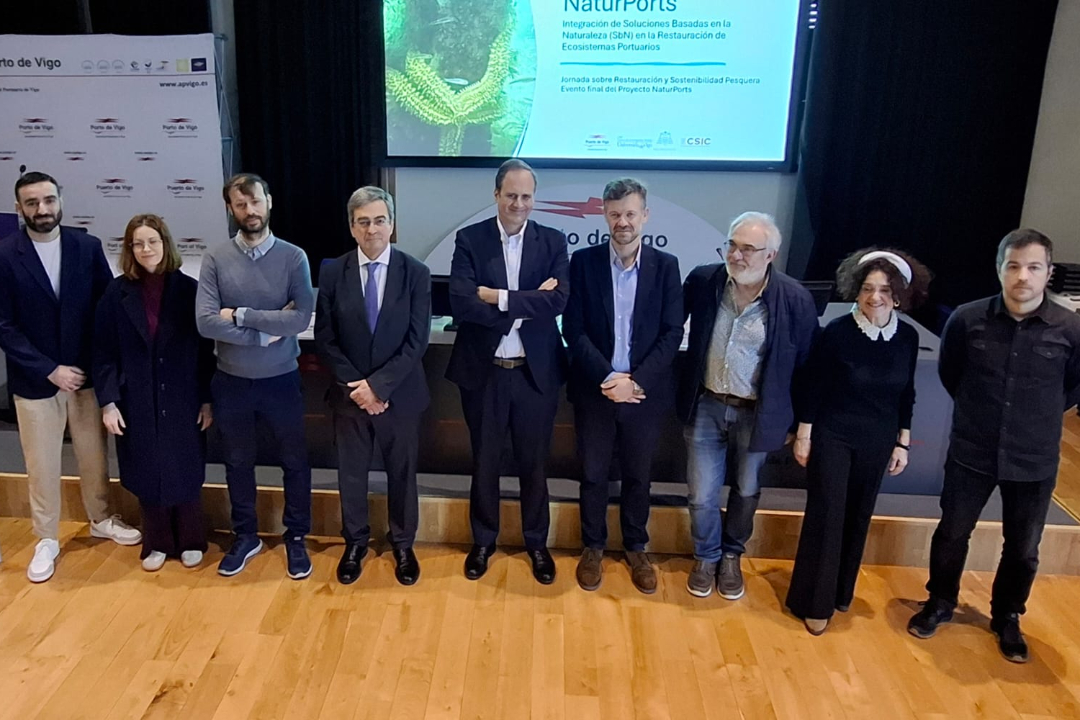
The
NaturPorts project, a pioneering initiative co-financed by the European Union
through the FEMPA, celebrated its final day this morning, consolidating its
position as a benchmark in the integration of Nature-Based Solutions (NbS) in
port environments. Coordinated by the Vigo Port Authority, in collaboration
with the University of Vigo, the University of Oviedo, and the CSIC, the
project has demonstrated that coastal infrastructure can be drivers of
biodiversity.
During the
final day of the presentation of results, Carlos Botana, president of the Vigo
Port Authority, emphasized that “NaturPorts is not just a restoration project;
it is proof that the future of our ports lies in real and productive
coexistence with the marine ecosystem.” In this context, he assured that,
thanks to this project, “we have demonstrated that it is possible to transform
degraded areas into enclaves of high ecological value that also directly
benefit the fishing sector.”
Scientific
milestones: From gray structures to living ecosystems
One of
NaturPorts' greatest achievements has been in the Port of Vigo, where the
installation of structures that mimic natural forms has allowed the
colonization of approximately 170 species. These units now serve as a refuge
for algae, octopuses, crabs, and small fish.
According
to Daniel Escobar, APV's environmental technician, no invasive species were
detected during the ecological characterization of the port's waters, so Botana
himself does not rule out extending this type of study to other locations to
further improve the quality of the port's waters.
Likewise,
the restoration of seagrass beds in Bouzas has led to the recovery of 0.2
hectares of eelgrass, which is essential for blue carbon sequestration,
improving water quality, and creating breeding grounds for commercially
important species. Similarly, according to IIM-CSIC researchers Isabel Medina
and Antón Salgado, a seagrass survival rate of between 72% and 98% has been
achieved, which is of great importance as it is a source of CO2 and nitrogen
capture and the best way to combat ocean acidification.
For his
part, Jorge Hernández, a researcher at IIM-CSIC, presented the HIPPO-REF
project, which consists of installing artificial shelters in various areas of
the port to encourage the settlement of seahorses. He explained that the first
two structures were installed yesterday in front of the Nautilus, which will
now be colonized by algae and invertebrates before being occupied by these
species of great ecological value, of which up to 15 seahorses have been
sighted in the port area in recent years.
The project
has also had a major impact in Asturias, specifically in the Port of Cudillero,
with sustainable barnacle farming pilots led by the University of Oviedo.
A
commitment to citizens
During his
speech, Botana also wanted to highlight the informative dimension of these
initiatives through environmental education, especially in the case of
children, and in this context, he highlighted the participation of 101,207
people who have visited the “Nautilus” underwater observatory since its opening
and who will soon be able to do so through the new viewer installed in Bouzas
under the “Peiraos do Solpor” program. In the president's opinion, these are
“the best tools for society to feel that the port is part of its natural
heritage.”
NaturPorts
is part of the “EU Mission: Restore our Ocean and Waters,” which allows us to
export our model to other European ports," he concluded.
Rock reef
pilot
For their
part, the research staff of the CIM, a partner in the project, presented in
detail the pilot project for biomimetic rocky reefs, one of the main actions of
NaturPorts aimed at restoring biodiversity in port infrastructures. In this
case, they were installed in three locations, adapting each reef to the
environment and ensuring that it fulfilled its ecological function from the
outset.
The results
obtained highlight that, in just ten months, the structures already showed high
colonization, with organisms from up to 349 different taxa (=groups of related
organisms), including algae and various invertebrates such as sponges and
ascidians, which subsequently attracted larger species of commercial value,
such as squid, octopus, spider crab, and velvet crab.
According
to project technician Rosalía Rodríguez, “after collecting all the data and
carrying out the analyses, the results were a success, so we can say that rocky
reefs are a good nature-based solution for restoring systems degraded by
humans.”
Finally,
Rosalía Rodríguez highlighted “the project's contribution to the balance
between port activity and marine conservation. The CIM's participation in
NaturPorts reinforces scientific knowledge and ecological restoration in port
environments, strengthening collaboration between marine research, ecological
innovation, and sustainability in European ports.”
Related projects