THE PORT OF VIGO HOSTS THE FIRST NATIONAL TECHNICAL CONFERENCE ON PORT WELFARE COMMITTEES
Oct 18, 2024, 10:00:00 AM
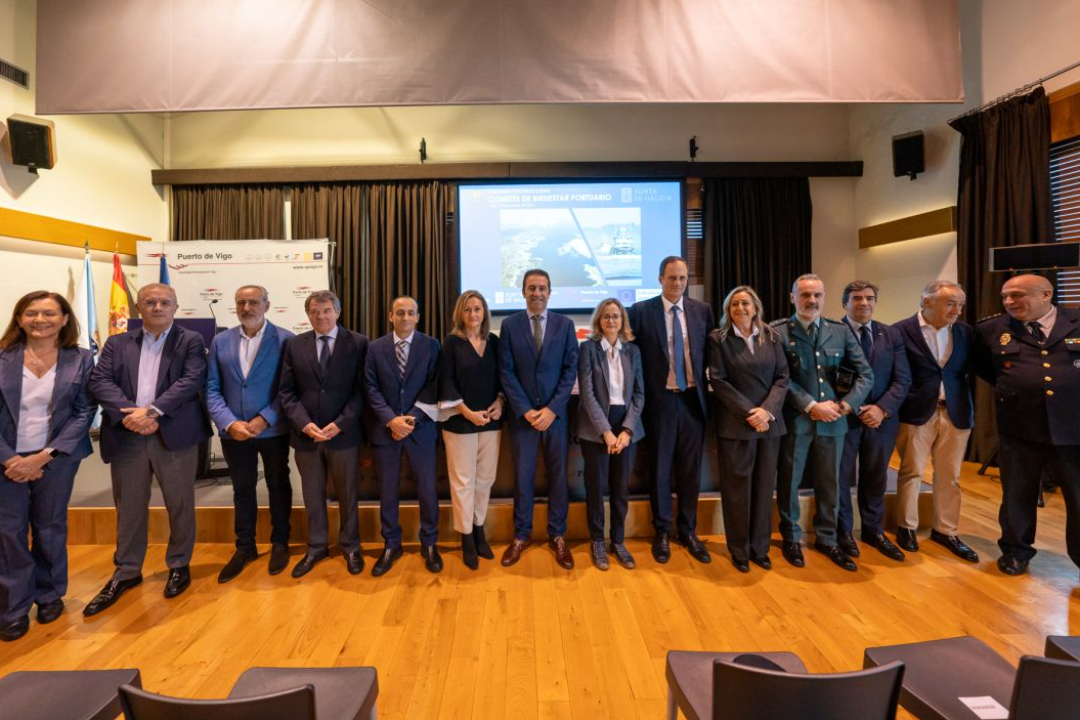
The Port of Vigo hosted the first-ever national technical sessions on Port Welfare Committees today. This event was born out of the conviction that the physical and mental well-being of maritime workers is a social demand and a priority for all involved administrations.
During the opening of the event, the Port Authority’s top official, Carlos Botana, accompanied by the Regional Minister of the Sea, Alfonso Villares, highlighted that "the immense work carried out by men and women connected to the sea also requires an immense effort." Therefore, the Welfare Committees are "extremely important" in "improving their working conditions."
In this context, he explained, the Port of Vigo's sustainable blue economy strategy is based on three fundamental pillars: economic, environmental, and, above all, social, which has led to the creation of a Welfare Committee, "the first of its kind in Galicia and along the Atlantic and Cantabrian coasts." A Committee "with many unique characteristics that make it one of a kind nationally and across Europe," as "being the leading fishing port in Europe gives us different needs than a commercial port." This is evident in the long stays of crews from freezer fishing vessels, where the Welfare Committee of the Port of Vigo aims to "support them" by addressing their needs, which range from healthcare, social services, and hospitality, to administrative procedures and providing a place for them to communicate with their families. Because "Vigo welcomes the people of the sea as part of one big family, where no one is an outsider."
In recent years, many activities have been carried out along these lines, with the creation of the Port of Vigo Welfare Committee being the greatest achievement. "We are working to be a friendly and healthy port," stressed the Port Authority president, citing examples such as the Futsal World Cup organized by Stella Maris over Christmas for deep-sea crew members, the 32 defibrillators—both fixed and mobile—installed by companies and institutions across various port spaces, and the CPR training provided to the workers of the Port Authority of Vigo.
The sessions were attended by over fifty participants who shared their personal experiences to improve the quality of life for maritime workers. Also present were former Regional Minister of the Sea and national deputy, spokesperson for the Agriculture, Fisheries, and Food Commission, Rosa Quintana; the president of Portos de Galicia, and the heads of the Galician Port Authorities of Marín, A Coruña, Ferrol, and Vilagarcía, "demonstrating their commitment to social improvement in Galician ports." Representatives from Puertos del Estado, directors of Stella Maris from the UK, Spain, and Vigo, representatives from Welfare Committees in Spain, and Works Councils from the ports of Vigo, Marín, and Ferrol, along with members of the Port Community of Vigo, were also in attendance.
The Welfare Committee of the Port of Vigo
After the inauguration, the Port president presented the success story of the Port of Vigo's Welfare Committee, which, as he emphasized, consists of 18 institutions that are "key players" in the maritime world and "know the sector and its needs firsthand." The committee also includes representatives from social and business groups, institutions, and state security forces.
This multidisciplinary approach fosters a working style based on dialogue and active listening among all its members, similar to the Blue Growth committees. This practice brings together different perspectives and sensitivities with a single goal: "to improve the quality of life for those who work at and visit the Port of Vigo" and has "proven to be the best participatory system for identifying deficiencies and finding collaborative solutions."