THE VIGO PORT AUTHORITY IS ORGANISING A WORKSHOP ON DECARBONISATION IN THE MARITIME AND FISHERIES SECTOR AT NAVALIA
May 18, 2026, 5:32:00 PM
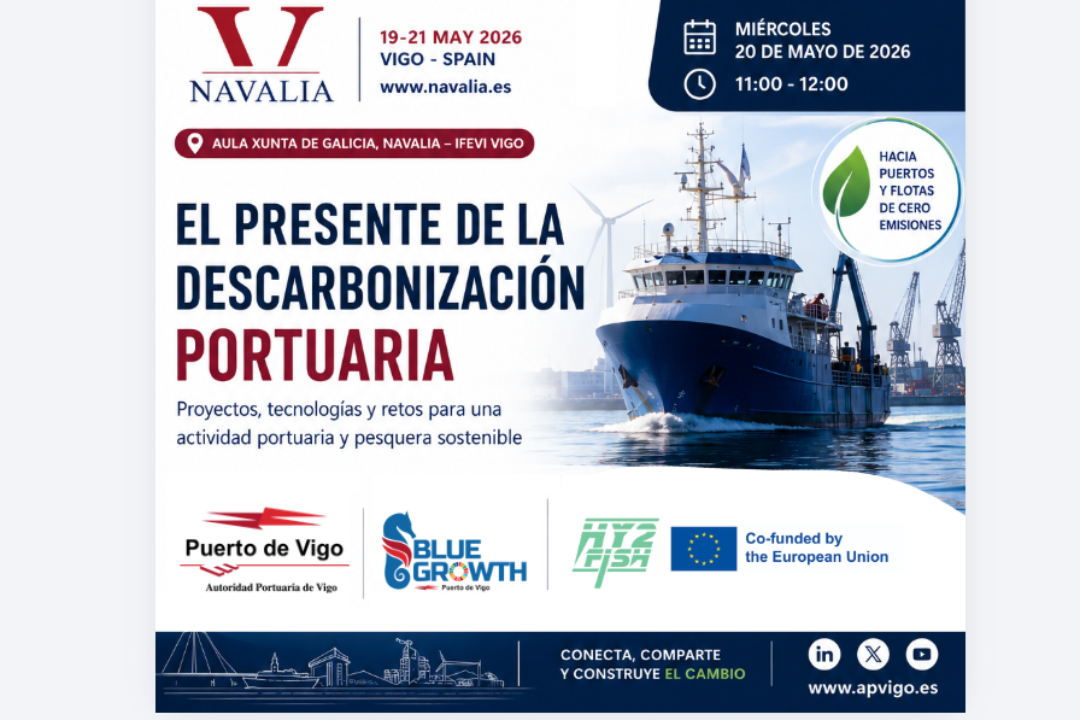
- The Blue Growth strategy will address the main challenges of the energy transition in the maritime sector, as part of a conference organised by the Vigo Port Authority.
- The session will bring together representatives from institutions, companies, technology centres and European projects linked to hydrogen, electrification and energy efficiency applied to the port and fishing sectors, with the aim of analysing the challenges of the energy transition and the implementation of new sustainable solutions in the maritime and port sector.
- The session will provide an opportunity to showcase projects and initiatives linked to hydrogen, energy efficiency and emissions reduction in the maritime and fishing sectors, including the European HY2FISH project.
The Vigo Port Authority will hold the conference “The Present of Port Decarbonisation” tomorrow, Wednesday 20 May, as part of the Navalia international trade fair. This technical session will focus on the challenges associated with the energy transition in the maritime-port and fishing sectors.
The conference is organised as part of the Port of Vigo’s Blue Growth strategy and will bring together institutional representatives, companies and technology centres involved in developing new solutions to reduce emissions in maritime activities.
The event will feature various presentations focusing on projects related to the decarbonisation of the fishing sector, green hydrogen, carbon capture and new energy technologies applied to the maritime-port environment, as well as a round-table discussion on the current state and upcoming challenges of the energy transition in ports. The
During the session, issues relating to the technological maturity of these solutions, infrastructure requirements, the regulatory framework and the economic viability of emerging technologies applied to the maritime and fishing sectors will be addressed.
With this initiative, the Vigo Port Authority reinforces its commitment to innovation and sustainability, promoting collaboration between industry, technology and the fishing sector to move towards a more competitive blue economy that respects the marine environment.
Among the initiatives to be presented during the event, the European HY2FISH project stands out.
European HY2FISH project
The event is taking place as part of the activities of the European HY2FISH project, an initiative aimed at developing a zero-emission demonstration fishing vessel powered by a hybrid system of hydrogen fuel cells and batteries.
The project involves the conversion and modernisation of an existing fishing vessel through the integration of new technologies designed to reduce emissions, including hydrogen-based propulsion systems, battery energy storage, flexible solar panels and smart energy management systems.
In this context, HY2FISH will enable the vessel “Julia Pico” to be transformed into a technology demonstrator designed to validate innovative energy solutions applicable to the European fishing fleet, with the aim of achieving reductions of up to 40% in fuel consumption and greenhouse gas emissions, as well as reducing underwater noise and operational costs.
The project, with a budget of €2.2 million, was selected under a specific call for proposals launched by the European Commission in February 2024, at the request of the European Parliament, with the aim of funding a single pilot demonstration project aimed at promoting the energy transition of the European fishing sector.
The call was aimed at initiatives capable of demonstrating the technical feasibility of innovative decarbonisation technologies applied to existing fishing vessels between 12 and 24 metres in length.
With a duration of three years (2024–2027), HY2FISH is funded by the European Climate, Infrastructure and Environment Executive Agency (CINEA) and brings together 13 organisations from eight European countries: Spain, Italy, France, Sweden, the Netherlands, Greece, Lithuania and Germany.
The project consortium is coordinated by ARVI and brings together technological, industrial, port and academic organisations with complementary capabilities for the development and validation of innovative decarbonisation solutions applied to the fishing sector.
These include the Vigo Port Authority (Spain), responsible for the vessel’s validation tests and the supply of hydrogen; AIMPLAS (Spain), specialising in plastic structures; INOTESA (Lithuania), in charge of engineering work; CENERGY (Italy), focusing on electrical systems; Next Horizon – NXH (France), responsible for the solar panels; and REGBES (Netherlands), specialising in energy control and efficiency.
The consortium also includes the University of Klaipėda (Lithuania), responsible for hull and propeller optimisation; RISE Research Institutes of Sweden (Sweden), responsible for hydrodynamic simulation; Wankel SuperTec (Germany), developer of the hydrogen engine; B&T (Greece), specialising in hydrogen tanks; and RINA Italy, RINA Spain and RINA Germany, responsible for the project’s certification processes.
Related projects